Things to do
Zarautz is a good place to do nothing and a good base from which to do everything: the longest beach in Gipuzkoa, an old town built for pintxos, and txakoli vineyards running down to the sea. San Sebastián, the Zumaia flysch and Gaztelugatxe are all under an hour and a half away — and you still come back to sleep to the sound of the waves.
Zarautz beach and surfing
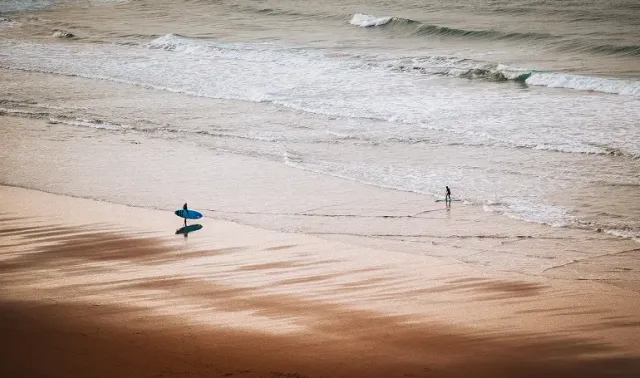
Zarautz beach is 2.5 km long, the longest in Gipuzkoa, and it is one minute on foot from the building. Fine sand, open to the Cantabrian Sea and with lifeguards in season, it works just as well for a swim in August as for a walk in January, when there is nobody about.
It is also one of the surf capitals of the Cantabrian coast. The waves are reliable almost all year, and there are several schools right on the promenade running beginner courses and renting boards and wetsuits, so there is no need to bring anything. If you already surf, autumn and winter are the best time: fewer people, better waves. If you are starting out, summer is kinder.
The seafront promenade is flat and runs the whole length of the beach. Above the town stands the hermitage of Santa Bárbara, a short climb with a view over the whole bay and the start of the vineyard walk towards Getaria.
1 minute on foot.
The old town, the market and pintxos
Behind the promenade the old Zarautz begins: narrow streets, houses with wooden balconies and a medieval tower. You can walk all of it in a short stroll, and it is where the town's life happens once the August crowds thin out.
This is where you go for pintxos, which in the Basque Country is not a sit-down dinner: it is moving from bar to bar having one in each. The custom is to order a pintxo and a zurito — a small beer — and walk on. It happens early, between eight and ten in the evening, and you do not book anywhere.
The municipal market, in a building from 1903, is 350 m from the apartment and has vegetables from the surrounding farmhouses, Idiazabal cheese, meat and fish from the Cantabrian Sea. It opens Monday to Friday 8:30–13:30 and 17:00–20:00, and Saturdays 8:30–13:30 — easily enough to walk down, shop and cook back at the apartment.
3 minutes on foot.
Getaria and the txakoli route
Getaria is the fishing village next door and probably the day out we recommend most. It is small, with a working harbour, and its outline from a distance — a hill pushing into the sea — has earned it the nickname of «the mouse». Fish is grilled out in the street, on coals set up in the doorways.
Two famous names came from here: Juan Sebastián Elcano, who completed the first voyage around the world, and the couturier Cristóbal Balenciaga, whose museum is in the village.
The best way to get there is on foot, along the pedestrian path that hugs the coast: about 4 km, completely flat, with no steps and separated from the road, and the sea beside you the whole way. It takes a little under an hour and is fine with a pushchair or a wheelchair. If you would rather climb, the txakoli route is the alternative: it goes up to the hermitage of Santa Bárbara and crosses the vineyards higher up.
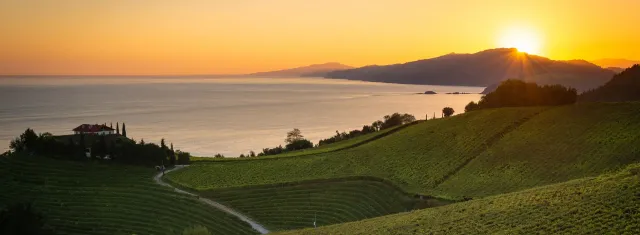
Txakoli is the local white wine, light and slightly sparkling, poured from a height. Several wineries on the hillside can be visited if you book ahead.
4 km away: an hour on foot along the coast, or 10 minutes by car.
The Zumaia flysch
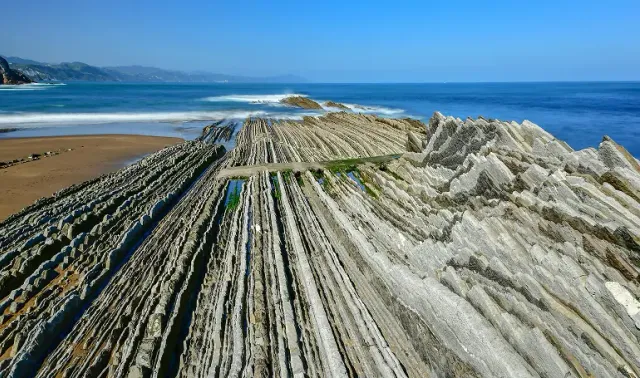
Flysch is rock stacked in layers like the pages of a book and tilted almost vertical by the cliff. Each layer is a stretch of time, and the cliffs between Zumaia and Deba hold some 60 million consecutive years of it, including the moment the dinosaurs went extinct. It is one of the best places in the world to see this, which is why the stretch is a Unesco geopark.
There are three good ways to take it in: from Itzurun beach, which is in Zumaia itself and within walking distance of the town centre; from the San Telmo hermitage right above it, which is the photo you have seen a thousand times; and by boat, on the trips that run from the harbour in season.
If you like walking, the coastal path between Zumaia and Deba follows the cliff edge for some 15 km.
11 km away: 15 minutes by car.
Donostia / San Sebastián
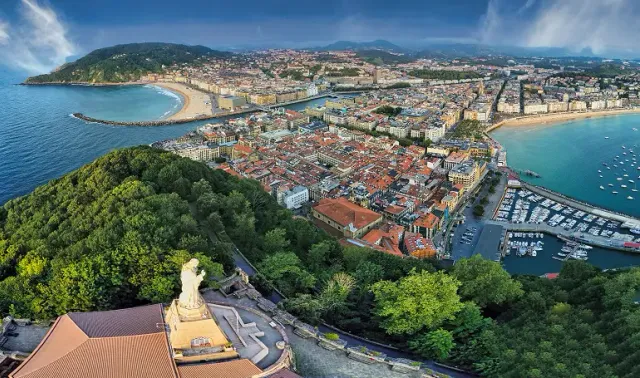
San Sebastián is close enough to spend the day and come back to sleep in Zarautz, which is a good deal quieter and a good deal cheaper.
Everything worth seeing is walkable: La Concha beach and its railing, Mount Urgull above the bay, the Old Town for pintxos — the same custom as in Zarautz, with more people — and Chillida's Wind Comb at the end of Ondarreta, three steel sculptures anchored in the rocks where the sea breaks. The San Telmo Museum, in the Old Town, tells the history of the Basque Country inside a 16th-century convent.
The train is the way to go. Euskotren leaves from Zarautz station, 400 m from the apartment, takes about 30 minutes to Amara and runs every half hour on weekdays. It drops you in the centre with no need to look for parking, which in San Sebastián is a real problem.
22 km away: 25 minutes by car or 30 by Euskotren.
Gaztelugatxe and the Bizkaia coast
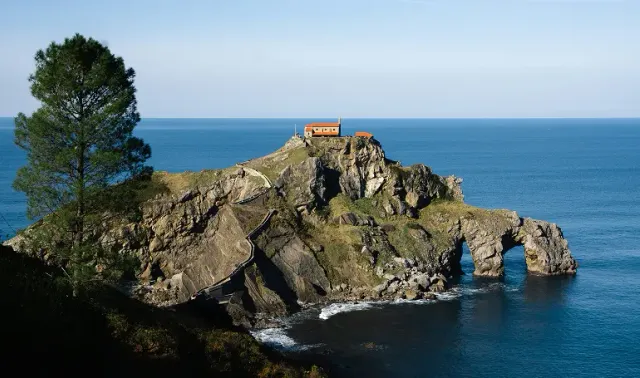
San Juan de Gaztelugatxe is a hermitage on top of an islet joined to the mainland by a stone bridge and 241 steps. The climb is demanding but short, and once up there the tradition is to ring the bell three times and make a wish. Between going down, crossing, climbing and coming back, allow two to three hours.
It is the most photographed spot on the Basque coast — it appeared in «Game of Thrones» — so it pays to go early. Entry is free, but in summer, at weekends and over Easter you have to book online in advance because access is controlled: worth checking a few days before you go.
Bakio is on the way, and a little further on Mundaka, home to the most famous left-hand wave in Europe. It is no beach for learning, but watching it break from the village is worth the stop.
About 90 km away: an hour and a quarter by car.
Getting around without a car
You can do the whole trip without a car, and plenty of people do. The Euskotren station is 400 m from the apartment and connects to San Sebastián and Bilbao with trains throughout the day. For the coast — Getaria, Zumaia, Deba — buses leave from the town. And all of Zarautz, beach included, is walkable from the front door.
If you are coming by car, bear in mind that parking in the centre in July and August is difficult: almost everything around the beach is metered or paid parking. The usual free alternative is the car park at the Asti sports area, on the way into town. We lend our guests a resident's permit that lets you leave the car in the zone without feeding the meter, at no extra cost; we only have one, and it goes to whoever asks first.
The nearest airports are San Sebastián, in Hondarribia, 40 km away, and Bilbao, 82 km away. The city of Bilbao itself is about 80 km, a little under an hour on the motorway.